
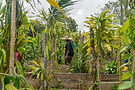
All About Vanilla
From the Mexican orchid to the plantations of Martinique — the history, botany, growing and curing of the vanilla pod.
Botany
Vanilla,
what is it?
The vanilla plant is a climbing vine of the orchid family. Once cured, its pods become either vanilla or "vanillon", depending on the species.
Vanilla grows on other plants, which it uses for support — it is a hemi-epiphyte. The vine climbs tree trunks using its roots like grappling hooks. Its delicate, pale-yellow, trumpet-shaped flowers grow around a flower bud.
1 morning
How long each flower blooms — you have to be ready to pollinate at the right moment
10–27 cm
The length of the vanilla pod — it reaches full size in 2 months
8–9 months
The time it takes for the pod to fully ripen
3–7 years
The wait before the first harvest after planting
The pod is harvested green and without scent — the vanilla aroma only appears after several weeks of traditional curing.
Frequently asked questions
What is the history of vanilla?
2,000 years ago
The Mayans and Aztecs
Pre-Columbian peoples already used vanilla to flavour their cocoa drinks. This wild orchid, native to Mexico, was naturally pollinated by the Melipona bee.
16th century
The Spanish conquistadors
The conquistadors discovered vanilla and brought it back to Europe. Attempts to grow it there failed for a long time — the Melipona bee, essential for pollination, does not live in Europe.
1841
Edmond Albius — the revolution
A 12-year-old enslaved boy, Edmond Albius, discovered a technique for hand-pollinating the vanilla flower. A few days later the pod formed — hand pollination was born, making it possible to grow vanilla all over the world.
1928
The golden age in Martinique
Martinique produced no less than 3 tonnes of vanilla. Large plantations thrived on the island, making Martinique vanilla an exceptional product.
20th century
The decline
The large plantations gradually disappeared. Hurricanes destroyed the crops, bananas and sugar cane proved more profitable, and hand pollination became too demanding.
2021
The revival — La Maison de la Vanille
Anaïs Janvier Chardon founded the Maison de la Vanille at Domaine de la Vallée — reviving a lost industry and putting "Made in Martinique" vanilla back on the map.
Did you know? Edmond Albius
It took nearly 22 years after vanilla arrived in Europe before Edmond Albius, a 12-year-old enslaved boy from Réunion, discovered hand pollination. His discovery revolutionised vanilla growing worldwide — yet he died in poverty, never recognised in his lifetime.
What are the different varieties of vanilla?
There are several species of vanilla around the world. Domaine de la Vallée grows the two varieties found in Martinique.
Martinique · Native
Vanilla mexicana Mill.
"Wild vanilla" · "Vanille marron"
Martinique's native vanilla plant. It grows wild on the island, but its fruit has no scent, so it is not grown commercially.
French Polynesia
Vanilla × Tahitensis
"Tahitian vanilla"
Grown in French Polynesia (Tahiti) and New Guinea. Known for its very distinctive floral and aniseed notes, it is prized by top pastry chefs.
Central America
Vanilla Pompona
"Banana vanilla" · "Vanillon"
Native to Central America, it is nicknamed "banana vanilla" because of the shape of its pod. Rare and precious, it is at the heart of the Maison de la Vanille project.
👉 Grown on the estate
South America · Indian Ocean
Vanilla Planifolia
"Bourbon vanilla"
The most widely grown vanilla in the world, mainly in the Indian Ocean. Introduced to Martinique by Father Labat, it is the reference vanilla for pastry and perfumery.
👉 Grown on the estate
How is vanilla grown in Martinique?
Vanilla only grows in a hot, humid tropical climate. It needs shade and well-drained soil rich in organic matter — ideal conditions in Morne-Rouge.
01
Step 1
Planting
First, one or two vines are placed on a living support tree. The vine climbs the trunk using its roots like grappling hooks.
- 2 to 3 years before the first flowering
02
Step 2
Flowering
Flowering is triggered by "stress" caused by the grower, who cuts back the shade above the vanilla plants. The plant reacts by producing flowers 3 months later. Each flower blooms for a single morning.
- A 2- to 3-month flowering period
03
Step 3
Hand pollination
Pollination is done by hand, using the technique discovered by Edmond Albius in 1841. Throughout the flowering period, growers must pollinate the flowers every day at the right moment.
- Daily work required
04
Step 4
Harvest
After eight to nine months of growth, the pods are ripe. They are harvested green and without scent — the vanilla aroma only appears after traditional curing. A pod measures between 10 and 27 cm.
8 to 9 months of growth
How is the vanilla pod cured?
The pods are harvested green and without scent. To bring out the vanilla aroma, they go through a traditional 4-phase curing process — long and painstaking work.
3 minutes
phase 1
Scalding
The green pods are dipped in water heated over an open flame. The aim is to stop the pod's growth and start the browning process.
24–48 h
phase 2
Sweating
The pods are immediately placed in boxes lined with blankets to keep in the heat. This turns the pods brown and develops vanillin and other aromatic compounds.
1-2 months
PHASE 3
Slow drying
Gradual drying, first in the sun and then in the shade, for one to two months. Slow drying removes moisture while concentrating the pod's aromas.
4-5 months
PHASE 4
Conditioning
The pods are stored in wooden trunks for four to five months. This final stage develops secondary aromas and refines the pod's complex fragrance.
In total — more than a year of patience
From pollinating the flower to a pod ready for sale, it takes 12 to 18 months of painstaking work.
1928
Vanilla & the French West Indies
An old, forgotten story — now being revived.
3 t
In 1928, Martinique produced no less than 3 tonnes of vanilla. Large plantations thrived on the island, making Martinique vanilla an exceptional, recognised and widely sold product. Several species were grown: Vanilla Planifolia, introduced by Father Labat, and Vanilla Pompona, known as "vanillon" in Martinique.
Those large plantations have now disappeared. Only a few small farms still produce small quantities. There are many reasons for this decline:
Hurricanes destroyed the plantations over the years
Bananas and sugar cane proved more profitable
Hand pollination is demanding and requires a lot of labour
The very long production time — several years before the first harvest
"Bringing vanilla back into Martinique's farming landscape and building a sector of excellence — that is the challenge Anaïs has chosen to take on."